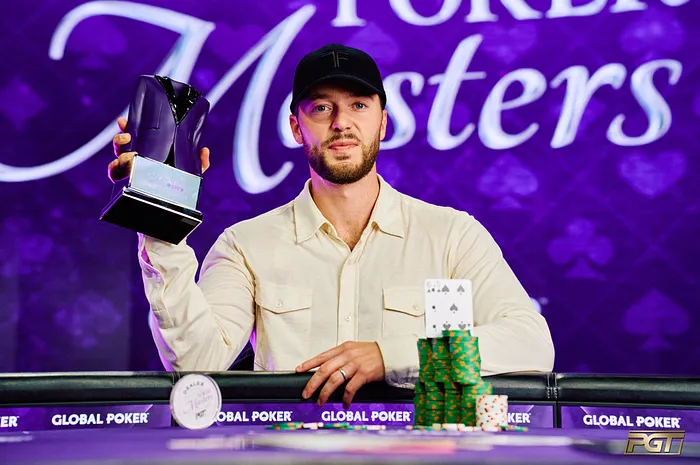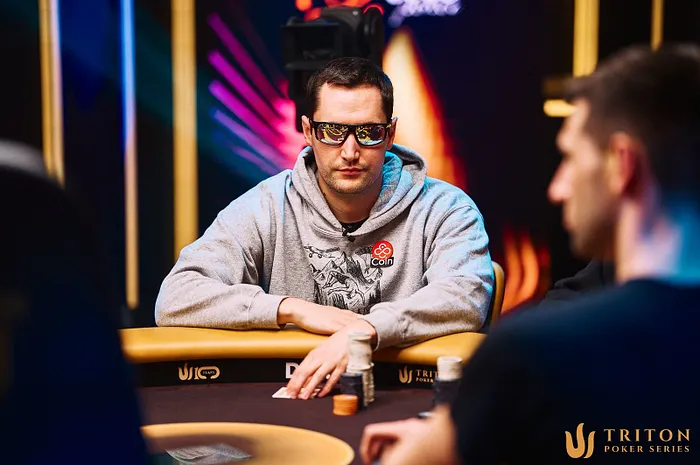
In the heads-up match of the Triton Jeju II $100,000 Main Event, Nick Schulman used pocket kings to defeat Austrian high-stakes professional Bernhard Binder, who reached showdown with K♣J♦. The hand analysis prepared by Lucas Robinson for PokerNews with the help of GTO Wizard showed that Schulman played in line with the optimal strategy at almost every stage, while Binder's decisions were rated GTO Disapproved several times.
Details
The hand took place during a heads-up battle between Poker Hall of Famer Nick Schulman and Bernhard Binder. The blinds were 500,000/1,000,000 with a 1,000,000 ante. Schulman had 37 million chips, or 37 big blinds, while Binder had 11.8 million, or 11.8 big blinds.
After an ICM deal, each player secured $3 080 112, while the fight for first place continued for the $3 854 888 payout. ICM is a model that values tournament chips based on the payout structure: their value is not always directly proportional to the number of chips.
Preflop, Schulman simply limped on the button with K♥K♠. GTO Wizard approved the decision. The solver recommends a polarized limping strategy: a player can play some of the strongest hands, including pocket kings, through a limp-trap, while also keeping weaker combinations in the range. Many medium-strength hands, by contrast, prefer to move all-in immediately.
For K♥K♠, calling produced the highest overall expected value. This line allowed Schulman to induce a raise from the big blind with weak hands. Since Binder had only 11.8 big blinds left, a very low SPR— the ratio of the effective stack to the pot—would arise after the flop, giving Schulman opportunities to extract maximum value on later streets.
Binder raised to 3.5 million with K♣J♦. The solver identified this decision as a deviation from GTO. According to the analysis, KJo—a king-jack offsuit—prefers to move all-in against a limp, while the 3.5-big-blind raise size is used with roughly 9% of the range, but KJo is not part of it. At the same time, the difference in expected value between raising and shoving was small, so the mistake was not considered costly. In the analysis, Binder's range was additionally locked to include KJo in order to reflect his play at the table more accurately.
Schulman again limited himself to a call with K♥K♠, and this decision also received a GTO Approved rating. Despite the natural desire to get all-in with kings, the solver recommends simply calling with the strongest pocket pairs—from 99 to AA. The big blind's 3.5-million raising range contained relatively few combinations with an ace, king, queen, or jack, since many of them preferred to move all-in preflop. Calling kept Binder's weaker hands in the pot, allowing them to continue bluffing or improve on later streets. At the same time, pocket kings in the calling range protected other hands from exploitation.
On the A♥8♦2♥ flop, the pot was 8 million. Binder bet 1 million, and Schulman called. The big blind had a significant range advantage: more equity and a higher share of the strongest combinations. Therefore, GTO Wizard recommended betting with the entire range, using sizes of 1 million, 2 million, or a 7.3-million all-in. However, the specific KJo combinations did not want to use the 1-million bet; for them, a 2-million bet, or 25% of the pot, or shoving were more profitable. Schulman's bet with K♥K♠ was once again a pure call: because of the big blind's range advantage, the small blind mostly continues by calling, using an all-in with only 9.7% of the range.
On the 5♣ turn, the pot grew to 10 million. Binder bet 2 million, and Schulman called. The 5♣ did not fundamentally change the relationship between the ranges, and the big blind still retained the advantage. The solver did often choose the 2-million sizing, but K♣J♦ was not among the hands recommended to use it. For this combination, checking was the best decision; when betting, KJo preferred an all-in and never used the 2-million size. The explanation is related to blockers: many hands containing a jack fold against an all-in, while relatively few hands containing a king or jack continue, making most KJo combinations poor bluff candidates. K♥Jx is an exception because it blocks some king-high flush draws capable of calling an all-in.
On the 10♦ river, the pot was 14 million. Binder checked, after which Schulman moved all-in for his remaining 4.3 million. After thinking for a long time, Binder called. Schulman showed K♥K♠, and the pocket kings were ahead of K♣J♦. With this hand, Schulman sealed the victory and won the $100K Triton Main Event, collecting $3 854 888.
The review of Binder's river decision received a GTO Approved rating: most of his king-high and queen-high hands preferred checking rather than bluffing. The solver selected hands from the very bottom of the range for bluffs, including 63o, 73o, 93o, 76s, and 96s, while allowing bluffs with KJo only at a very low frequency.
Comment from the “Vse-o-Pokere Editorial Team”
For participants in high-stakes tournaments, this hand shows how heavily strategy depends not only on the strength of one's own hand, but also on range structure and stack sizes. A practical challenge for businesses and professional players is correctly distinguishing a mathematically minor deviation from a decision that genuinely changes the financial outcome. In poker and gambling projects, it is also important to establish the rules, calculations, and decision-making logic in advance, especially when large sums are at stake. We advise and support clients on poker, casinos, gambling, and the regulation of gambling activities. Our team helps assess risks and build processes tailored to the specific project format and applicable requirements.